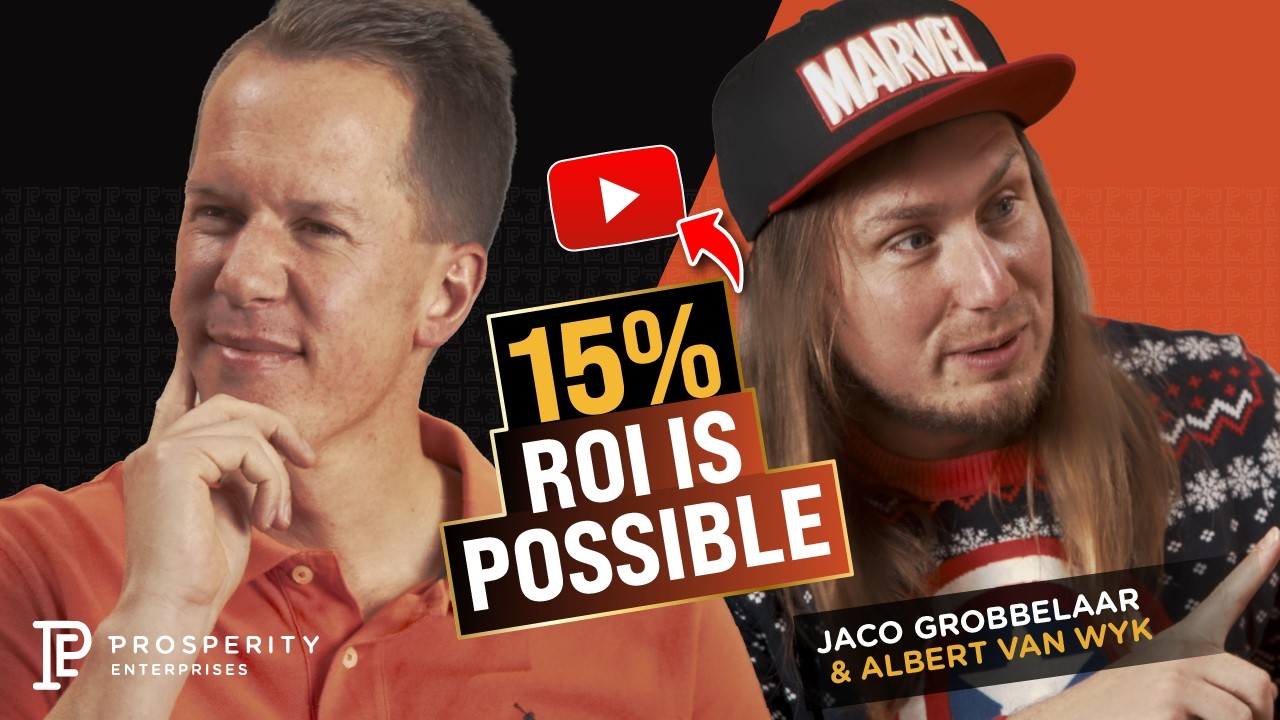


DIFFERENT APPROACHES. SHARED PRINCIPLES. ONE LONG-TERM VISION.
Put two experienced property investors around a table and you will quickly discover something interesting: we don’t necessarily agree on everything.
Albert van Wyk and I have both built substantial property portfolios. We both believe passionately in property as a vehicle for wealth creation. We both use multi-let strategies, believe in financial education and think investors need to take a long-term view.
Yet our approaches can be remarkably different.
Albert loves full-title properties. I predominantly invest in sectional title. Albert wants significant positive cash flow from each individual property. I am prepared to make less per property if the model allows me to repeat the process at scale. We even have slightly different philosophies around leverage.
And that is precisely what makes our conversations so valuable.
The lesson isn't that there is one perfect property strategy. It is that successful investors understand the principles, find a strategy suited to their strengths and then become exceptionally good at executing it.
Why Property?
Albert’s argument for property starts with something tangible: bricks, cement, land and labour.
Property is a real asset. As the cost of constructing new properties rises over time, existing property has an underlying replacement value. Albert also sees property as protection against the long-term deterioration of the purchasing power of currency.
My biggest attraction to property, however, is leverage.
With most investments, you invest your own capital and earn a return on that capital. Property gives you the opportunity to use bank financing to acquire a much larger asset and participate in the rental income and potential capital appreciation of the entire property.
Imagine putting R200,000 into improvements on a R2 million property financed largely by a bank. Your economic exposure is not simply to the R200,000 you contributed; you are controlling a R2 million asset.
That ability to use other people’s money responsibly is one of the fundamental reasons I believe property can be such a powerful wealth-building vehicle.
Then there is the most basic economic principle of all: supply and demand.
People need somewhere to live.
Regardless of economic cycles, political changes or market sentiment, shelter remains a fundamental human need. South Africa also has a growing population, which means millions of people will continue requiring homes in the decades ahead.
Three Mistakes That Stop Investors From Scaling
During our conversation, Albert identified three mistakes that he believes repeatedly trap property investors.
First, they maximise their personal affordability too quickly. They buy one or two properties that consume all their available borrowing capacity and suddenly discover that they cannot continue acquiring assets.
Second, they purchase investment properties in their personal names without adequately considering the structure they will eventually need if the portfolio becomes substantial.
Albert experienced this himself. He initially accumulated five properties personally before restructuring his approach. Once I established the appropriate entities for him, he found it far easier to expand his portfolio.
Third, investors repeatedly purchase cash-flow-negative property.
Instead of every new property strengthening their financial position, every acquisition requires additional money from their salary. The bigger their portfolio becomes, the more pressure they create.
This brings us to a principle I emphasise constantly:
Your structure is the foundation on which you build your property portfolio.
At Prosperity Enterprises, the investment structure we commonly recommend involves a Family Trust and then a Holdings Trust holding the shares in a property company. The exact structure must, of course, be determined according to an investor’s circumstances with appropriate professional tax, legal and estate-planning advice.
The objective is to think about asset protection, estate planning, financing capacity and taxation before building substantial wealth rather than trying to restructure everything afterwards.
As we put it during our conversation, trusts should not only be considered by people who are already wealthy. They should be considered by people who intend to become wealthy.
Stop Asking: “Where Should I Invest?”
One of the questions Albert and I receive constantly is:
“Where are you buying property?”
It is probably the wrong question.
Albert calls his approach home-field advantage.
He concentrates heavily on specific parts of Pretoria. He knows his market to such an extent that he understands differences not merely between suburbs, but between individual streets and even sections of streets.
He knows where people walk. He knows the parks, traffic patterns, crime considerations and amenities. He understands what tenants want and what individual properties should be worth.
No national property report can replace that knowledge.
I follow exactly the same principle in Johannesburg. My portfolio is heavily concentrated in the northern suburbs because I understand the area. I know the employment nodes, transportation routes, complexes, levies, rental demand and individual pockets.
There are also enormous operational advantages.
If your properties are close together, your agents can show several units without driving across the city. Maintenance teams can move quickly between properties. Contractors become familiar with your portfolio. Management becomes easier and costs can fall.
The lesson is simple:
Don't chase somebody else's hotspot. Become the expert in your own market.
Scaling Requires Cash Flow or Capital Growth
Albert made another powerful observation during our discussion: to scale a portfolio aggressively, you generally need one of two engines — strong rental yield or strong capital growth.
Strong rental yield creates cash that can be reinvested, used to service debt, build reserves and support further acquisitions.
Capital growth creates equity. When an investor can buy intelligently, renovate, develop or otherwise create additional value, that growing equity can strengthen the balance sheet and potentially provide capacity for further investment.
The ideal situation is obviously achieving elements of both.
This is where Albert and I have developed different strategies.
Albert focuses heavily on full-title properties. He loves their flexibility. A three-bedroom home can potentially become a six-bedroom property. Garages can sometimes be converted, additional accommodation may be added, and land can potentially be developed, subject to the relevant approvals.
I have built much of my portfolio using sectional-title properties.
Why?
Scalability.
My approach is almost like a factory.
I can purchase similar two-bedroom townhouses, convert them into three-bedroom configurations where appropriate, furnish them for my multi-let model and repeat the process. Instead of reinventing the investment every time, I have developed a repeatable system.
Albert described the difference beautifully: his model is more like producing unique cars individually; mine is closer to running a production line.
Neither is inherently better.
They solve different problems.
The Strategy That Changed My Portfolio
One area where Albert has had an enormous influence on me is room rentals.
I previously pursued a strategy that looked promising but did not perform as expected as economic and market conditions changed.
Instead of stubbornly sticking to it, I adapted.
I took what I had learned from Albert about room rentals and applied those principles to my sectional-title portfolio. We converted suitable properties into smaller multi-let investments, significantly improving their rental performance.
That experience reinforced one of the most important lessons of my investing career:
Learn from other successful investors, but don't copy them blindly.
Take the principles and adapt them to your circumstances.
Albert and I can disagree about sectional title versus full title and both still succeed because our backgrounds, locations, resources, teams, skills and objectives are different.
There is no universal property formula.
Property Is Not a Get-Rich-Quick Scheme
Perhaps the most important part of our conversation was about time.
Investors constantly chase the latest suburb, strategy or extraordinary return. Someone announces that they are generating an exceptional yield somewhere and suddenly everybody wants to buy there.
That isn't investing. That's chasing.
Albert asks a much better question:
Where do you want to be 20, 30 or 50 years from now?
Property should be approached as a generational game.
Build the correct structure. Understand financing. Buy cash-generating or value-creating assets. Develop deep knowledge of your market. Build systems. Reinvest. Scale responsibly. Protect what you create.
And keep learning.
When Albert asked me during our rapid-fire questions to name the one thing every property investor should know, my answer was immediate:
Property education is the most important investment you can make.
Because ultimately, the greatest asset in your portfolio isn't the first property you buy.
It's the knowledge that allows you to buy the next 10, 20 or 100 wisely.
Albert and I may take different roads, but the destination is the same:
Build assets. Build cash flow. Build knowledge. And ultimately, build wealth that can outlive you.
– Jaco Grobbelaar
Watch as Albert van Wyk and Jaco Grobbelaar from Prosperity Enterprises unpack the strategies, structures and investment principles that can help property investors move beyond owning one or two properties and start building a scalable property portfolio.